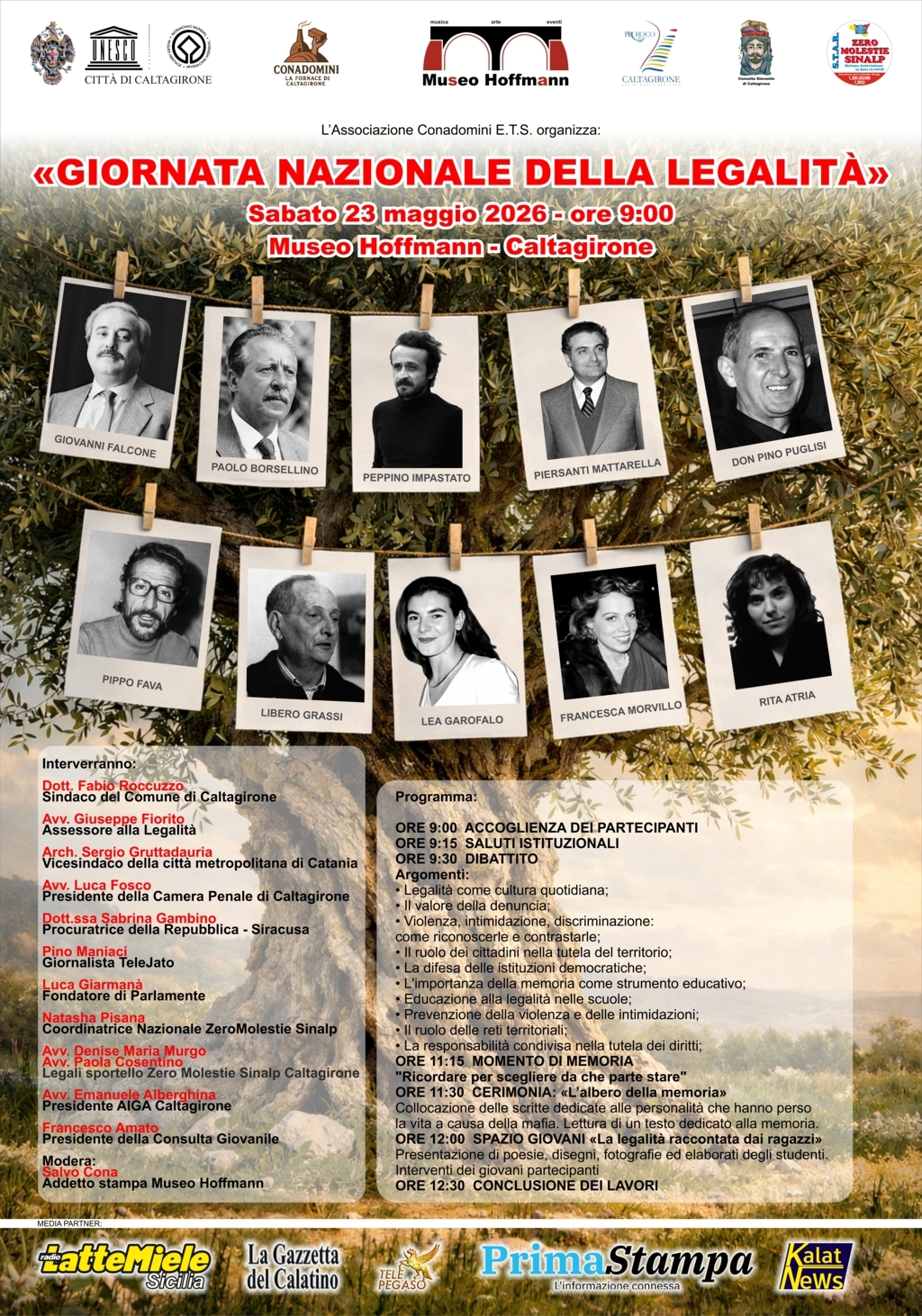
The Hoffmann Museum in Caltagirone hosted the National Legality Day, an event dedicated to the memory of the victims of the Mafia, civic education and the promotion of a culture of legality.
Organized by Associazione Conadomini E.T.S., the initiative involved institutions, the judiciary, the legal profession, associations, the world of communication and young people from the local area. Its aim was to turn remembrance into concrete commitment, promoting legality as an everyday value and a shared responsibility.
The event took place at the Hoffmann Museum in Caltagirone, a venue that once again confirmed its cultural and social vocation, becoming a space for discussion, memory and active participation.
An event dedicated to the culture of legality
The programme of the National Legality Day included institutional greetings, debates, moments of reflection, contributions from young people and a symbolic ceremony dedicated to the memory of those who lost their lives because of the Mafia.
During the meeting, several key issues for the civic growth of the community were addressed:
- legality as an everyday culture;
- the value of reporting wrongdoing;
- the fight against violence, intimidation and discrimination;
- the role of citizens in protecting the local area;
- the defence of democratic institutions;
- the importance of memory as an educational tool;
- legality education in schools;
- shared responsibility in the protection of rights.
The initiative aimed to deliver a clear message: legality is not an abstract concept, but a daily choice that concerns every citizen.
Speakers at the National Legality Day
The event was attended by numerous representatives from institutional, judicial, professional and association sectors.
Speakers included:
Lawyer Giuseppe Fiorito, Councillor for Legality;
Arch. Sergio Gruttadauria, Deputy Mayor of the Metropolitan City of Catania;
Lawyer Luca Fosco, President of the Criminal Chamber of Caltagirone;
Dr Sabrina Gambino, Public Prosecutor of Siracusa;
Luca Giarmanà, founder of Parlamente;
Natasha Pisana, National Coordinator of ZeroMolestie Sinalp.
Also present were Lawyer Denise Murgo, legal representative of Zero Molestie Sinalp Caltagirone; Lawyer Rosangela Morello, Treasurer of AIGA Caltagirone; and Francesco Amato, President of the Youth Council.
The event was moderated by Salvo Cona, press officer of the Hoffmann Museum.
Compared with the announced programme, journalist Pino Maniaci was unable to attend the initiative. The organizers send him their sincere best wishes following the accident he had that very morning.
The memory of Falcone, Borsellino and the victims of the Mafia
The day focused on the memory of symbolic figures in the fight against the Mafia and in the defence of justice: Giovanni Falcone, Paolo Borsellino, Peppino Impastato, Piersanti Mattarella, Don Pino Puglisi, Pippo Fava, Libero Grassi, Lea Garofalo, Francesca Morvillo and Rita Atria.
Their faces and names accompanied the entire event, becoming a visual, educational and moral reference point for all participants.
Remembering these figures means reaffirming the value of choice, courage and civic responsibility. Memory, in fact, must not remain confined to commemoration, but must become a tool for awareness and action.
The Tree of Memory at the Hoffmann Museum
One of the most meaningful moments of the event was dedicated to the Tree of Memory, planned as a symbolic ceremony with the placement of signs dedicated to the figures killed by the Mafia.
In the garden of the Hoffmann Museum, the olive tree became a symbol of roots, peace, memory and continuity. The images and names of the victims of the Mafia were placed among its branches, transforming the museum’s outdoor space into a place of collective reflection.
This gesture gave concrete form to the central theme of the initiative: remembering in order to choose which side to stand on.
Young people as protagonists of legality education
A large part of the event was dedicated to young people, who were present not only as members of the audience, but also as active participants.
The participation of the Scouts was one of the most important aspects of the event. Legality education begins with school, listening, dialogue and the opportunity to give new generations the tools to recognize injustice, intimidation, discrimination and behaviour that goes against civil coexistence.
The presence of young people confirmed the educational value of the initiative and made the National Legality Day at the Hoffmann Museum an intergenerational moment of discussion. The entire organization thanks the AGESCI Caltagirone 1 Scouts, and in particular group leaders Francesca Forti and Daniele Forti, who attended with the three branches: Clan, Reparto and Branco, the youngest children.
Art, music and anti-Mafia memory
The day was not limited to institutional debate. The programme was also enriched by artistic and performative moments, with music and visual interventions dedicated to the theme of anti-Mafia memory.
The creation of a mural, curated by the Youth Council and inspired by the memory of Falcone and Borsellino, gave the initiative a contemporary language close to young people. Urban art transformed remembrance into an image, leaving a visible mark in the space and strengthening the connection between culture, legality and participation.
Music also helped make the event more engaging, showing how legality can be communicated through different languages: words, images, sound and collective presence.
The Hoffmann Museum as a civic and cultural space
With this initiative, the Hoffmann Museum in Caltagirone confirms its role as a place open to the city, capable of hosting not only cultural, artistic and musical events, but also moments of civic reflection.
The National Legality Day transformed the museum into a space of active memory, where institutions, professionals, associations and young people came together to reaffirm the value of justice, participation and responsibility.
The Hoffmann Museum thus presents itself as a cultural landmark for the local area, a place where memory becomes a shared experience and an opportunity for community growth.
Conclusion: remembering in order to choose which side to stand on
The National Legality Day at the Hoffmann Museum in Caltagirone left a strong and timely message: the memory of the victims of the Mafia must continue to speak to new generations.
To remember means to know.
To know means to choose.
To choose means to take responsibility for building a freer, fairer and more aware community.
Through discussion, the participation of young people, the Tree of Memory, music and art, the Hoffmann Museum helped transform memory into a living, visible and shared experience.